
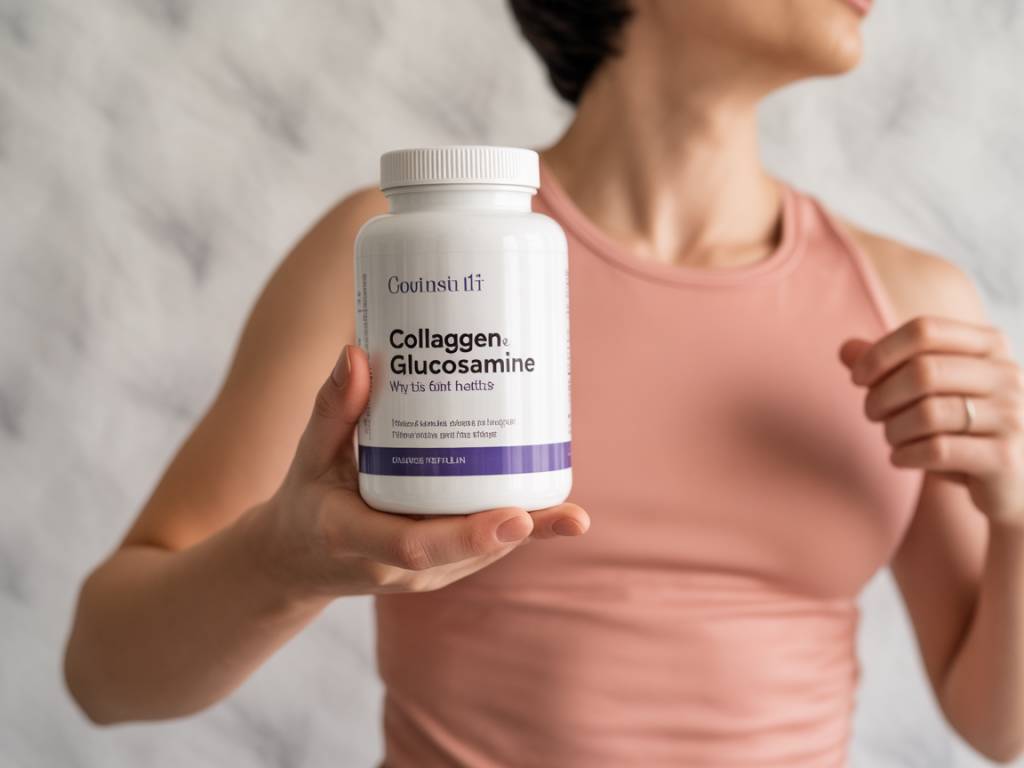
Collagen glucosamine: why this duo is a game-changer for joint and skin health
Your knees click on the way down. Your shoulder protests every overhead press. And that face staring back at you in the bathroom mirror? It’s doing its best, but the skin looks like it’s been through a few too many rounds. None of this is weakness — it’s biology. After 30, your body starts quietly cutting production of the very compounds that keep you moving and looking sharp. The good news: you can fight back. And the smartest way to do it is with a pair of nutrients that work better together than anything else in the supplement aisle — collagen and glucosamine.
Collagen glucosamine: why this duo is a game-changer for joint and skin health
Most men don’t connect joint pain with skin ageing. They treat them as separate problems — one a sports issue, the other vanity. But both stem from the same root cause: the breakdown of connective tissue. Collagen provides the structural protein that holds your tendons, ligaments, skin, and cartilage together. Glucosamine is the building block your body uses to synthesise and maintain that cartilage. When both decline simultaneously — and they do — the result is stiff joints, slower recovery, and skin that’s lost its density and resilience. Address one without the other and you’re only solving half the problem.
What collagen actually does in the male body
Collagen is the most abundant protein in the human body, accounting for roughly 30% of your total protein content. It forms the scaffolding of your skin, tendons, ligaments, and bones. The problem is that collagen synthesis drops by approximately 1% per year after the age of 25 — and by your late 30s, you start to feel the consequences.
- Skin thickness and elasticity: Clinical trials show that daily collagen peptide supplementation (5–10g) significantly improves skin hydration, elasticity, and dermal density in men over 35 after just 8 weeks of consistent use.
- Tendon and ligament integrity: Collagen is rich in glycine and proline — amino acids essential for repairing and reinforcing connective tissue after training loads or injury.
- Muscle recovery: Glycine, found in high concentrations in collagen, promotes deeper sleep cycles, which is when the bulk of muscular and tissue repair actually happens.
- Wound and injury healing: Lower collagen levels are directly linked to slower healing times — something any active man past 35 will have noticed without necessarily knowing why.
What to look for: Choose hydrolysed collagen (also called collagen peptides). This form has been broken down into smaller chains that absorb significantly faster than whole collagen protein. Marine-sourced hydrolysed collagen has shown particularly strong bioavailability in recent research.
What glucosamine brings to the table
Glucosamine is a naturally occurring compound found in cartilage. Your body produces it, but output decreases with age and accelerates under the mechanical stress of regular training, heavy lifting, or running. When glucosamine levels fall short, cartilage starts to thin — and thinning cartilage means friction, inflammation, and the early stages of osteoarthritis.
- Cartilage synthesis: Glucosamine sulfate is a direct precursor to the glycosaminoglycans that make up cartilage structure. Without it, your joints can’t effectively rebuild between training sessions.
- Inflammation control: Multiple meta-analyses confirm that glucosamine sulfate supplementation significantly reduces joint pain and stiffness associated with osteoarthritis, particularly in the knees and hips.
- Long-term joint preservation: A three-year clinical study published in The Lancet found that glucosamine sulfate not only reduced pain but also slowed the structural narrowing of the knee joint space — suggesting genuine disease-modifying effects, not just symptom management.
- Mobility and range of motion: Men rebuilding post-surgery or managing chronic joint issues consistently report improved flexibility and ease of movement after 6–12 weeks of glucosamine supplementation.
Critical distinction: Always opt for glucosamine sulfate, not glucosamine hydrochloride. The sulfate form is the version studied in the most robust clinical trials and consistently outperforms in real-world outcomes.
Why combining collagen and glucosamine amplifies results
These two compounds don’t just coexist — they operate on complementary pathways that reinforce each other’s effects. Collagen rebuilds the structural framework of joints (tendons, ligaments, the collagen matrix within cartilage itself), while glucosamine fuels the synthesis of the cartilage tissue sitting between bones. One repairs the walls, the other lays down the floor.
Research directly comparing combined supplementation versus either compound alone shows measurably better outcomes in three key areas:
- Joint pain reduction: Combination protocols produce faster and more significant reductions in pain scores than single-compound approaches, particularly for men with moderate-to-severe joint discomfort.
- Post-exercise recovery: The anti-inflammatory action of glucosamine stacks with the amino acid profile of collagen to shorten recovery windows — useful for anyone training more than three times per week.
- Skin structural support: While glucosamine is primarily known for joint benefits, emerging research suggests it also supports skin hydration by promoting hyaluronic acid synthesis — working in parallel with collagen to improve skin quality from two different angles.
How to supplement smart: dosage and timing
Getting results from collagen and glucosamine isn’t complicated, but consistency and quality matter more than quantity. Here’s what the evidence points to:
- Collagen peptides: 5–10g per day, ideally taken around training sessions or before bed when tissue repair is most active.
- Glucosamine sulfate: 1,500mg per day, taken with food to improve absorption and reduce the chance of mild gastric discomfort.
- Add vitamin C: Collagen synthesis is vitamin C-dependent. Without adequate vitamin C, the conversion of proline to hydroxyproline — a critical step in collagen formation — is impaired. 500mg alongside your collagen is a practical and well-evidenced addition.
- Stack with omega-3s or turmeric: Both have strong anti-inflammatory credentials and work synergistically with glucosamine to reduce joint inflammation, particularly for men carrying old injuries or high training volumes.
- Give it time: Expect 4–6 weeks before joint comfort improves noticeably, and 8–12 weeks for visible skin changes. These are structural repairs, not overnight fixes.
Who benefits most from this combination
While any man over 30 will see some return from collagen and glucosamine supplementation, certain profiles benefit most rapidly and significantly:
- Active men over 35 experiencing longer recovery times, persistent joint aches, or reduced range of motion.
- Lifters and endurance athletes placing high repetitive stress on knees, hips, shoulders, and ankles.
- Men recovering from joint injuries or surgery, where cartilage and connective tissue repair is a priority.
- Men noticing visible skin ageing — particularly loss of firmness around the jaw, under-eye hollowing, or skin that’s slower to recover from dehydration or stress.
- Desk-bound men with stiff hips and lower back tightness, where reduced synovial fluid and cartilage compression are common issues.
The bottom line on collagen and glucosamine for men
There’s nothing trendy about collagen and glucosamine. They don’t promise miracle transformations or dramatic before-and-after photos. What they offer is quieter and more valuable: a measurable, evidence-backed way to slow down the structural decline that comes with age and physical demand. Better joint comfort, faster recovery, more resilient skin, and the ability to keep performing at the level you’ve built — for longer.
One body. Maintain it like it matters.
À propos de l'auteur