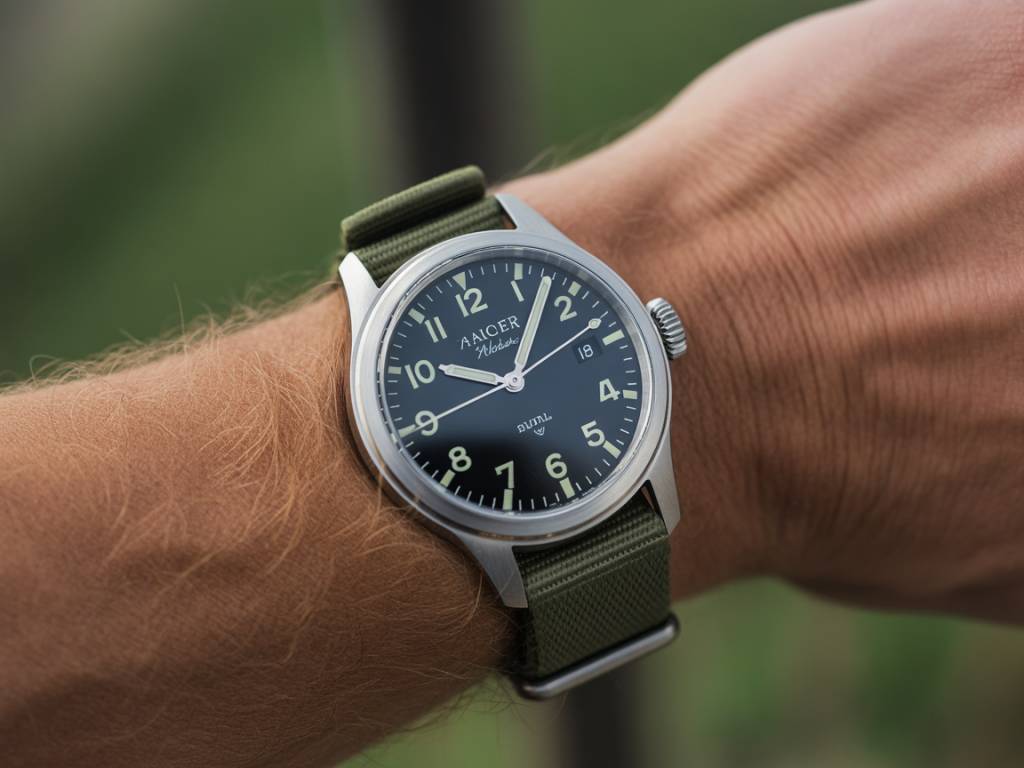
The quiet rise of the minimalist field watch
Somewhere between the bulky dive watch and the fragile dress watch, a quieter icon has taken shape on men’s wrists: the minimalist field watch. Clean dials, simple numerals, rugged cases and muted straps—these watches are as understated as they are capable. They don’t beg for attention; they earn respect.
It’s no accident that, in an era of smartphones and smartwatches, analog field watches are thriving. They speak to something deeper in contemporary masculinity: a desire for reliability over spectacle, for adventure that feels real rather than curated, and for style that works as hard as you do. The field watch has become a subtle manifesto in stainless steel and canvas.
From trenches to taxis: the military roots of the field watch
Field watches were born out of necessity, not fashion. Early in the 20th century, soldiers needed timepieces that were legible, durable and accurate in harsh conditions. The pocket watch was too slow, too delicate and too impractical in combat. So the wristwatch—at the time seen as slightly unmanly—was reimagined as a tool of war.
The formula was straightforward:
- High-contrast dials that could be read at a glance
- Simple, bold numerals instead of ornate indices
- Robust cases that could take hits, drops and water spray
- Mechanical movements designed to keep ticking in tough conditions
- Straps that could be easily swapped or replaced in the field
These wartime designs laid the groundwork for what we now recognize as a “field watch.” When soldiers came home, many kept their watches, and the aesthetic followed them into civilian life—onto job sites, into garages, onto hiking trails and eventually into city streets and offices.
Today’s minimalist field watch is, in many ways, a refined echo of that history. The unnecessary has been stripped away. What remains is a pure expression of function that just happens to look effortlessly cool.
Why minimalism matters in a world of constant noise
Modern life is saturated with information, notifications and branding. Our devices are trying to say something every second. Against that backdrop, a restrained, analog field watch sends a different kind of message: presence instead of distraction.
Minimalist field watches resonate so strongly right now because they align with a broader shift in how men approach style and identity:
- Intentionality over excess: Owning fewer, better things rather than chasing every new drop.
- Authenticity over flash: Choosing objects that reflect who you are, not who you’re trying to impress.
- Capability over decoration: Wearing gear designed to perform, not just to be seen.
The field watch is a quiet rebellion against the hyper-styled, hyper-branded world. It doesn’t need polished gold or rotating bezels to prove anything. A matte dial, slim case and fabric strap are enough. The simplicity becomes a statement: I’m here to do, not just to display.
The evolving face of masculine style
What we call “masculine style” has changed dramatically over the last decade. It’s less about rigid uniforms—suits, shiny shoes, oversized luxury watches—and more about personal narratives: where you’ve been, what you value, how you live.
Field watches fit naturally into that evolution. They suggest a man who is:
- Comfortable blending city and outdoor aesthetics
- More interested in craftsmanship than pure status signaling
- At ease moving between roles—professional, partner, friend, explorer
There’s a subtle duality at play. On one hand, the field watch is rugged and utilitarian. On the other, its restrained design works perfectly with a crisp Oxford shirt, a wool blazer or Japanese denim. It nods to adventure without being cosplay.
You can wear the same minimalist field watch to a client meeting, a weekend hike and a late-night bar. It doesn’t scream “office” or “outdoors.” It just works, in the same way a well-cut navy chore jacket does. That versatility has become a core symbol of modern masculinity: the ability to cross environments and contexts without needing to reinvent yourself every time.
Adventure, authenticity and the analog mindset
The appeal of the field watch isn’t just about how it looks—it’s about how it feels to live with it. When you check the time on a minimalist analog dial instead of your phone, something shifts.
You’re not dragged into messages and feeds. You glance, register the time, and stay present. That micro-habit of analog checking becomes a small act of reclaiming your attention.
There’s also a tactile romance to it: the satisfying click of the crown as you set the time, the gentle sweep or tick of the seconds hand, the way the strap breaks in and shapes itself to your wrist. It’s slow, physical, imperfect—and that’s precisely the point.
Field watches tap into a narrative of adventure that feels grounded rather than performative. You don’t have to be summiting peaks every weekend. The watch simply says: I’m prepared to go. If plans shift from coffee to a trail walk, from a city commute to a last-minute road trip, this one object on your wrist is ready.
The design language of minimalist field watches
What makes a field watch “minimalist” rather than just “simple”? It comes down to intentional design choices that strip the watch back to its strongest lines and purposes.
- Dial: Usually matte—black, dark green, navy or sand—reducing glare and visual noise. Numerals are clear, often Arabic, with restrained minute markers.
- Case: Typically between 36–40 mm, thin enough to slide under a cuff, thick enough to feel substantial. Finishes are matte, brushed steel or bead-blasted for a tool-like feel.
- Hands: Simple baton or syringe shapes, often with lume for low light, emphasizing legibility over ornament.
- Straps: Nylon NATO, canvas, or leather, all easy to swap. Colors tend to be earthy: olive, tan, charcoal, brown.
- Complications: At most, a date window or 24-hour markers. No chronographs, no busy sub-dials—just time, maybe date.
The power of this design language is that it interacts with your wardrobe instead of dominating it. Whether you’re wearing a T-shirt and worn chinos or a subtle flannel suit, the watch blends in and elevates without needing the spotlight.
What to look for when choosing your minimalist field watch
If you’re considering adding a field watch to your daily rotation—or making it your only watch—there are a few key factors worth focusing on.
- Size and fit: For most wrists, 36–38 mm offers a timeless, understated look. If your wrists are larger or you prefer a bolder presence, 39–40 mm can still feel balanced and not overpowering.
- Movement: Quartz movements are accurate, affordable and low-maintenance. Mechanical or automatic movements add charm and craftsmanship, along with the ritual of winding or wearing to keep them ticking.
- Legibility: The core of a field watch. Check how easily you can read the time in both daylight and low light. Overly stylized fonts or glossy dials defeat the purpose.
- Durability: Look for stainless steel cases, decent water resistance (at least 50 m for everyday life), and a sapphire or hardened mineral crystal if you’re rough on your gear.
- Versatility: Neutral dial colors and standard lug widths (like 18 or 20 mm) make it easy to change straps and adapt the watch to different outfits and seasons.
- Restraint in design: When in doubt, remove. If a logo or text feels too big, or the dial looks crowded, it will probably age poorly. Simpler designs tend to outlast trends.
Think of your field watch as you would a great pair of boots or a go-to jacket: it should work almost anywhere, with almost anything you wear, and it should feel better the more you live in it.
Integrating a field watch into your everyday style
One of the strengths of the minimalist field watch is how easily it adapts. A few approaches to make it your signature:
- The daily uniform upgrade: If your go-to look is jeans or chinos, a tee or Oxford shirt and sneakers or boots, a field watch completes the picture. It adds a sense of intention to casual clothes.
- Office-ready functionality: Paired with a button-down, knit tie and blazer, a field watch on a leather strap looks quietly professional—especially in workplaces where full suits are rare.
- Weekend and travel companion: Swap to a NATO or canvas strap for trips and downtime. The watch feels more relaxed, more ready for whatever the day becomes.
- Subtle personal signature: Play with strap textures and colors to reflect your character—olive for the outdoors-leaning guy, charcoal for the minimalist, tan leather for the vintage-inspired wardrobe.
Over time, the watch and strap will develop wear that’s unique to you: creases in the leather where you bend your wrist, faint scratches on the case that tell stories you may not even remember. That personal patina is part of its appeal.
Why the field watch endures
Minimalist field watches have become more than just another accessory trend. They sit at the intersection of function, aesthetics and identity: a small, unassuming object that reflects a bigger set of values—clarity, capability, quiet confidence and a readiness for real life, not just the curated version.
In a world that keeps asking you to speed up, shout louder and show more, a simple field watch offers a different path: strip away the excess, keep what works, and move forward with intention. On the wrist, that philosophy looks like a matte dial, three hands and a strap that feels right when you tighten it before stepping out the door.